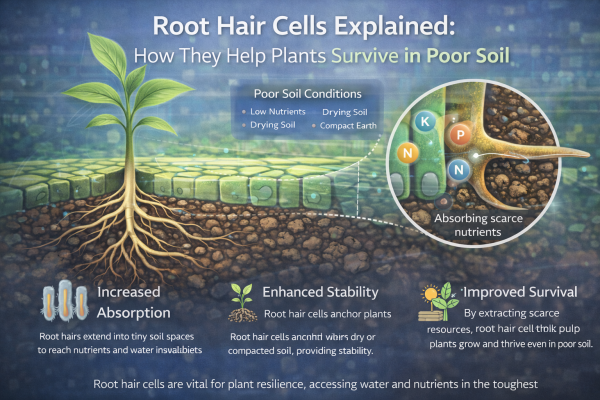
Root Hair Cells Explained: How They Help Plants Grow in Poor Soil
Plants cannot walk to find better soil. If the ground is dry, sandy, or low in nutrients, the plant must still survive where it is. One of the best tools a plant has for this job is the root hair cell.
Root hair cells are tiny cells on young roots. They grow long, thin "hair-like” extensions that reach into the spaces between soil particles. These hairs do not "hunt” for food. Instead, they increase contact with the soil so the plant can take in more water and mineral ions. This is a key reason many plants can grow even when soil quality is poor.
Seneca Learning
+1
This blog explains what root hair cells are, how they work, and why they matter most in poor soil.
What are root hair cells?
Root hair cells are specialised epidermal cells found near the tips of roots. They are most common in the root hair zone of young roots. Each cell forms a long extension called a root hair.
These hairs are very small, but there are lots of them. Together, they create a large "absorbing surface” around the root. This helps the plant take in resources faster than a smooth root surface could.
Seneca Learning
+1
Why plants struggle in poor soil
"Poor soil” usually means one (or more) of these problems:
Low water (dry soil, sandy soil, fast drainage)
Low minerals (not enough nitrates, phosphates, potassium, magnesium)
Low organic matter (less nutrient storage)
Bad structure (soil packed too tightly, fewer air gaps)
Wrong pH (nutrients become harder to absorb)
In these conditions, the plant needs better absorption. Root hair cells help with that.
The main job: increase surface area
A simple idea explains most of their power:
More surface area = more absorption
Root hairs make the root’s surface much larger without needing a thick or heavy root. This means more soil contact, more water entry points, and more places for mineral ions to move into the plant.
Organismal Biology
+1
Think of it like this:
A smooth root is like a straight straw.
A root with many hairs is like a straw wrapped in a sponge.
The sponge touches much more water, even if water is scarce.
How root hair cells absorb water (osmosis)
Water usually enters root hair cells by osmosis.
Osmosis is the movement of water from a place with more water (higher water potential) to a place with less water (lower water potential), through a partially permeable membrane.
Here is what matters in the soil:
Soil water contains dissolved minerals.
The inside of the root hair cell often has more dissolved substances than the soil water.
So, water moves into the root hair cell.
In poor soil, water may be limited. Root hairs help because their large surface area gives the plant more chances to absorb the small amount of water available.
Siyavula
+1
How root hair cells absorb minerals (active transport)
Mineral ions are not always absorbed the same way as water.
In poor soil, mineral levels can be very low. Sometimes the plant needs to move ions from a low concentration outside to a higher concentration inside the cell. That cannot happen by passive movement alone.
So the plant uses active transport.
Active transport:
needs energy (ATP)
uses membrane proteins to move ions
can move substances against a concentration gradient
OpenStax
+1
Root hair cells are well suited for this because they have many mitochondria, which help supply the energy needed for active transport (this is a common GCSE point). The result is simple: even if the soil has only a small amount of minerals, the plant can still pull in what it needs.
Why root hair cells matter most in poor soil
Root hair cells are helpful in all soils. But they become critical in poor soil because:
1) They reach into tiny gaps
Soil is not solid. It has spaces. Water and minerals sit in thin films around soil particles. Root hairs extend into these small spaces and improve contact.
2) They reduce "shortage stress”
When water and minerals are limited, every extra absorption point matters. More hairs mean more entry routes.
3) They help build a stronger root system
With better absorption, the plant can:
make more cells
grow new roots
support leaves and photosynthesis
recover faster after dry periods
So root hairs support growth from the bottom up.
Key adaptations of root hair cells (GCSE-friendly)
Root hair cells have features that match their role:
Long hair-like extension → more surface area for absorption
Seneca Learning
+1
Thin cell wall → short distance for water to move
Siyavula
Large vacuole → helps maintain water movement into the cell (by keeping cell sap concentrated)
Many mitochondria → supports active transport of mineral ions (energy demand)
OpenStax
+1
These adaptations are why root hair cells are often used as a strong example of "structure fits function”.
A quick link to mycorrhiza (bonus, but useful)
In very poor soil, plants often rely on help from fungi called mycorrhizae. Fungal threads can spread through soil and improve mineral uptake. Root hairs still matter because they are the plant’s main contact surface and a key part of the absorption zone. (If you want, I can write a separate blog on mycorrhizae.)
Practical tips: how to support healthy root hair cells (for gardening blogs)
If your audience is gardeners or farmers, these points help:
Avoid waterlogged soil: too much water removes air, and roots struggle.
Do not over-fertilise: harsh salts can damage delicate root hairs.
Improve soil structure: compost or organic matter helps retain water and minerals.
Water steadily: extreme dry-to-flood cycles stress roots.
Do not disturb roots often: root hairs form on young roots and break easily.
Healthy root hairs = better uptake = stronger growth, especially in weak soil.
Summary
Root hair cells are small, but they make a big difference. They help plants grow in poor soil by:
increasing surface area for absorption
Organismal Biology
+1
taking in water mainly by osmosis
Siyavula
taking in mineral ions using active transport when needed
OpenStax
+1
When soil is dry or low in nutrients, these cells can be the reason a plant survives and continues to grow.