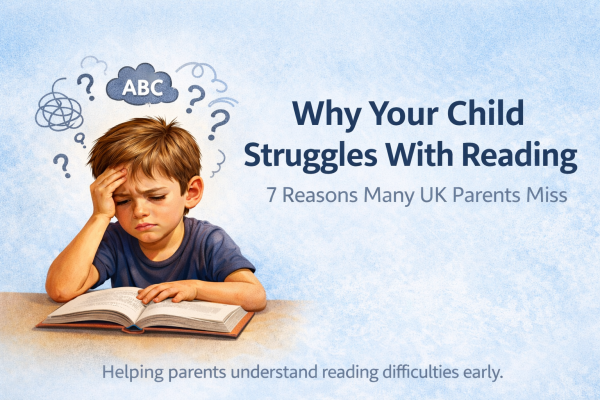
Many parents across the UK quietly worry when their child avoids books, hesitates while reading aloud, or becomes frustrated during homework time. At first, it might seem like a phase. Some children simply take longer, right?
But what if the difficulty isn’t about effort or intelligence at all?
In reality, many young learners face challenges that are subtle, easy to overlook, and rarely explained clearly to families. These hidden factors often affect confidence, learning progress, and emotional wellbeing long before teachers raise concerns.
This guide is written for parents who want clarity — not blame, not panic — just honest understanding. By recognising the real reasons early, families can offer the right support and help children reconnect with learning in a positive way.
Long before formal schooling begins, children show small signs that shape how they approach books later. These signals don’t look like problems — which is why they’re often missed.
Some children:
Found it hard to recognise sounds in nursery
Avoided rhyme games or word play
Preferred visual activities over language-based ones
These behaviours don’t mean something is "wrong”. They simply suggest that language processing developed differently.
When early development patterns are not supported properly, difficulties can appear once classroom expectations increase. At that stage, many children feel confused rather than helped.
What parents can do:
Gentle observation matters. Listening, storytelling, and relaxed conversations often reveal more than worksheets ever will.
One of the most common yet misunderstood challenges is fear.
Many children know the words — but freeze when asked to read aloud. This isn’t laziness. It’s pressure.
Reading in front of adults or classmates can:
Trigger self-doubt
Increase hesitation
Cause children to rush or guess
Over time, anxiety creates avoidance. Children stop practising, which makes progress slower, reinforcing the cycle.
Why this matters:
Confidence plays a major role in literacy development. Without emotional safety, improvement becomes harder even with good teaching.
Support tip:
Let children practise privately. Praise effort, not speed. Confidence often unlocks ability.
Many parents assume reading is just about recognising words. In reality, it depends on several underlying abilities working together.
These include:
Sound recognition
Memory recall
Vocabulary understanding
Sentence processing
When one of these elements is weaker, reading feels exhausting. Children may decode words correctly but fail to understand meaning — which leads to frustration.
This is why some learners read fluently yet cannot explain what they’ve just read.
Key insight:
Language foundations are built gradually. Missing pieces don’t fix themselves without targeted support.
Every child processes information differently. Some learn by listening. Others need visuals or hands-on interaction.
In busy classrooms, teaching methods are often standardised. While this works for many pupils, others struggle quietly because the approach doesn’t match how their brain works best.
This mismatch can affect:
Engagement
Retention
Motivation
Children may begin to believe they are "bad at reading”, when in reality the method simply doesn’t suit them.
What helps:
Personalised guidance, adaptive techniques, and patience can dramatically change outcomes.
For some children, reading requires intense concentration. Every sentence feels like heavy work.
This often happens when:
Working memory is overloaded
Processing speed is slower
Too many skills are demanded at once
Mental fatigue causes children to lose focus quickly. They may appear distracted, but internally they are overwhelmed.
Important note:
This has nothing to do with intelligence. Many bright children experience cognitive overload without proper strategies.
Not all learning happens at school.
Children who associate books only with tests, corrections, or pressure often disengage emotionally. On the other hand, those exposed to stories, humour, and relaxed reading environments build positive associations.
When reading feels like a chore, motivation disappears.
Try this instead:
Read together casually
Let children choose books freely
Celebrate curiosity, not accuracy
Enjoyment often comes before improvement.
Many parents are told to wait. Sometimes this is appropriate. But sometimes waiting allows small gaps to grow.
Early guidance is not about labels — it’s about prevention.
When support arrives at the right time:
Confidence increases
Progress feels achievable
Emotional stress reduces
Delaying help often makes recovery harder later.
Specialist online tutoring offers flexibility, personalised pacing, and a safe learning environment. Sessions can focus on understanding rather than performance.
Children often respond positively when:
Lessons match their pace
Mistakes feel safe
Guidance is consistent
Parents also gain insight into how their child learns best.
True improvement happens when emotional needs and academic guidance work together.
Effective support:
Strengthens understanding
Builds trust
Encourages independence
Confidence transforms effort into progress.
Every child’s journey is unique. Struggles don’t define ability — they simply highlight areas needing care.
With patience, awareness, and the right guidance, children can rediscover confidence and joy in learning.
If you’ve recognised any of these signs, early support can make all the difference — not just academically, but emotionally too.
Looking for expert online reading tutors in the UK?
ReadWithUs provides personalised reading support to help children improve understanding, confidence, and fluency.
👉 Start Your Free Consultation