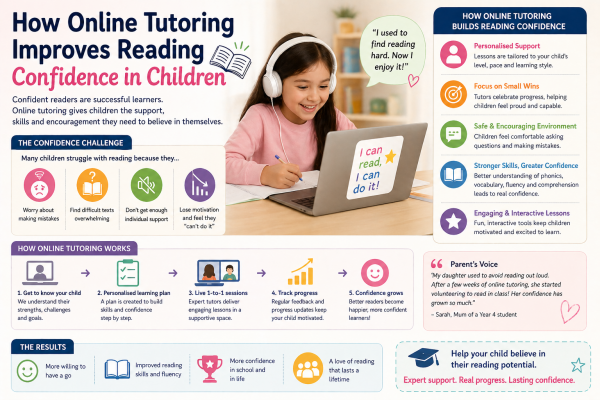
How Online Tutoring Improves Reading Confidence in Children
Reading confidence is not just about "being good at reading.” It is about how a child feels when they see a page of text. A confident reader will try. They will take a guess. They will keep going even when a word is hard. A child with low confidence may freeze, avoid reading, or say, "I can’t do it,” before they even start.
Online tutoring can help change this. It can support children who are behind, children who feel nervous, and children who simply need the right approach. When online tutoring is done well, it does more than improve reading skills. It builds belief, calm, and consistency.
Below are the main ways online tutoring can improve reading confidence, step by step.
1) It gives children a safe space to practise
Many children feel judged when they read out loud. They worry about getting words wrong. In a classroom, they may feel watched. At home, they may feel rushed. This pressure can reduce effort.
Online tutoring can feel safer because:
the setting is familiar (home)
it is usually one-to-one
the tutor can slow down without embarrassment
the child gets more speaking time
Confidence grows when a child realises, "I can try here and it’s okay if I make mistakes.”
2) It offers personal attention that a classroom cannot always give
In school, teachers have many students. They cannot always focus on one child’s exact needs. Some children need extra support with sounds. Others need help with speed, meaning, or tricky spelling patterns.
A good online tutor can spot what the child actually needs, such as:
phonics and decoding
blending sounds smoothly
recognising common words faster
reading with expression
understanding what they read
When support matches the child’s real gap, progress becomes faster. And when progress becomes visible, confidence rises.
3) It breaks reading into small, achievable steps
Confidence is built through wins. Small wins, repeated often, change mindset.
Online tutoring can do this well because sessions are structured. A tutor can set a clear focus, such as:
"Today we will practise the ‘sh’ sound.”
When a child sees a clear goal and reaches it, they feel capable. This matters more than long sessions that feel confusing.
4) It provides fast feedback that feels supportive
Children often lose confidence when they do not know what they did wrong. Or when they only hear "No” without a helpful explanation.
Online tutoring allows quick feedback like:
"Good try. Let’s look at the first sound.”
"That word has two parts. Let’s split it.”
"You fixed it. Great. Read the whole sentence again.”
This kind of feedback builds skill and confidence at the same time. It also teaches children that mistakes are part of learning, not proof of failure.
5) It uses tools that make reading easier and more fun
Online tutoring can include simple digital supports that remove stress, such as:
highlighting text as the child reads
larger fonts and clear spacing
interactive word games
short quizzes and quick checks
shared screens with reading passages
These tools help children stay focused. They also make reading feel less heavy. When reading becomes easier to start, confidence has room to grow.
6) It builds routine, and routine builds confidence
Many children struggle because reading practice is not regular. They read once, then stop for a week, then feel behind again. This cycle harms confidence.
Online tutoring often creates a steady routine, such as:
two sessions per week
short homework tasks between sessions
quick review at the start of each lesson
Routine reduces anxiety. The child knows what to expect. They feel prepared. This is especially helpful for children who feel nervous about reading.
7) It helps children choose the right books and texts
Some children lose confidence because the reading material is too hard. Others lose interest because the material feels boring.
A tutor can match texts to:
the child’s reading level
the child’s interests
the child’s age
This matters because the right text creates flow. The child reads more smoothly. They understand more. And they start to enjoy reading, which is the strongest form of confidence.
8) It supports parents without turning reading into stress at home
Parents often want to help. But reading practice can turn into arguments if the child feels pressured.
Online tutoring can reduce this stress because:
the tutor leads the learning
the parent does not need to "teach”
home reading becomes calmer and shorter
the child stops linking reading with conflict
When reading at home becomes easier, the child is more willing to practise. More practice leads to more progress. More progress leads to more confidence.
9) It improves key reading skills that directly affect confidence
Reading confidence is strongly linked to a few core skills:
a) Decoding (reading the words)
If a child cannot decode words, reading feels scary. A tutor can build decoding through simple phonics practice and repeated patterns.
b) Fluency (reading smoothly)
Slow, choppy reading can make a child feel "bad at reading.” Tutors can use short repeated readings to build smoothness.
c) Vocabulary (knowing what words mean)
If a child reads words but does not understand them, they feel lost. Tutors can teach meanings in a simple, clear way.
d) Comprehension (understanding the text)
Understanding builds confidence. A tutor can ask simple questions that help a child "get the story” instead of just saying words.
When these skills improve, confidence improves naturally. The child starts to feel in control.
10) It tracks progress clearly, so children can see they are improving
Children need proof that they are getting better. Without proof, they may still believe, "I’m not good at reading,” even after progress.
Online tutoring can track progress through:
reading level checks
speed and accuracy over time
word lists mastered
comprehension scores
recorded reading samples (with consent)
Seeing improvement changes self-talk. It turns "I can’t” into "I’m getting better.”
What to look for in a good online reading tutor
Not all tutoring is equal. If you want confidence to improve, look for a tutor who:
uses patient, positive language
gives clear steps, not vague advice
can explain phonics and reading skills simply
chooses level-appropriate texts
sets small goals each session
shares progress updates with parents
Avoid tutors who rush, shame, or overload the child with long, difficult passages.
Simple ways to support confidence between sessions
You can help at home with short, calm habits:
10 minutes of reading, not 60
praise effort ("You kept going”) more than perfection
re-read favourite texts for fluency
let the child choose the book sometimes
stop before the child gets tired
Confidence grows when reading feels achievable and safe.
Conclusion
Online tutoring can improve reading confidence because it gives children personal support, a safe space to practise, clear steps, and steady routine. It helps them build real reading skills, and it helps them feel proud of progress. Over time, confidence turns into willingness. Willingness turns into practice. And practice turns into strong reading.