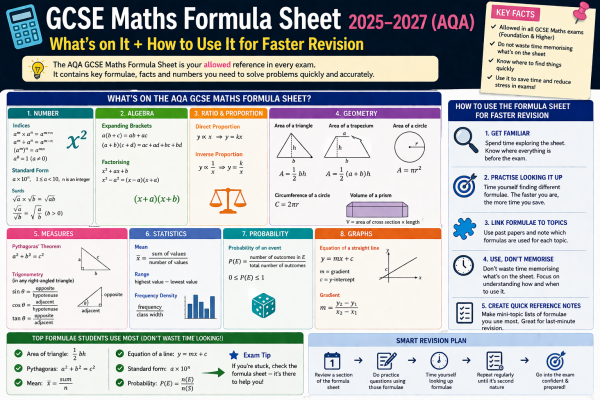
AQA has confirmed that students sitting GCSE Maths in 2025, 2026 and 2027 will be provided with a formulae sheet, and that the 2025 sheet is the same as the one used in 2024. AQA also states the formulae sheet will be provided as an insert with every question paper. AQA
That support is real, but it is not a shortcut. The formula sheet helps most when you train with it the way you will use it under time pressure: spotting which formula applies, substituting accurately, checking units, and keeping your calculator work clean. If you do that, revision becomes faster because you spend less time second-guessing and more time collecting method marks.
This guide covers both Foundation and Higher. You will see exactly what is printed on each AQA formula sheet, what extra items appear on Higher, what is still not provided, and how to revise so the sheet becomes a speed tool rather than a comfort blanket.
The Department for Education decision led to Ofqual changing rules so exam boards must provide formulae and equation sheets for GCSE mathematics in 2025–2027. GOV.UK+1 AQA’s own update summarises this for their GCSE Maths papers and confirms the 2025 content has not changed from 2024. AQA
The practical meaning is simple: in the exam, you are not being tested on memorising every listed formula on the sheet. You are being tested on using them correctly inside real exam questions that still require reasoning, rearranging, interpreting diagrams, and showing method.
Students hear "formula sheet” and assume it removes the need to learn formulae. It does not.
First, the sheet only contains a selected list, not everything you might need. Second, AQA’s specification appendix makes it clear that in general students are expected to know many formulae and they are not given in the exam (in a normal assessment model). AQA Even in 2025–2027, questions will still demand core knowledge, because the sheet doesn’t teach you which formula applies or how to rearrange it.
You will revise faster if you treat the sheet as a reference that reduces memory load, while you continue building the real GCSE skills: recognising the topic, forming an equation, substituting correctly, and communicating method.
The AQA Foundation formula sheet includes geometry, Pythagoras and trigonometry (right-angled triangles), compound interest, and a key probability identity. AQA Filestore
The sheet gives the area of a trapezium and the volume of a prism, plus circle circumference and area. AQA Filestore
Area of a trapezium:
Area = 1/2 × (a + b) × h, where a and b are the parallel sides and h is the perpendicular separation.
Volume of a prism:
Volume = area of cross section × length.
Circle formulae:
Circumference = 2πr = πd, where r is radius and d is diameter.
Area = πr².
These look straightforward, but the marks usually come from what happens before the substitution. For example, a "trapezium” question often hides the perpendicular height inside a right triangle, or asks you to find a missing parallel side by rearranging.
The Foundation sheet includes Pythagoras and the three trigonometric ratios for right-angled triangles. AQA Filestore
Pythagoras: a² + b² = c², where c is the hypotenuse.
Trig ratios (right-angled triangle):
sin A = opposite / hypotenuse
cos A = adjacent / hypotenuse
tan A = opposite / adjacent
The sheet gives the ratios, but it does not label "opposite” and "adjacent” for you. That labelling skill is a major source of marks.
The sheet includes the compound interest formula. AQA Filestore
Total accrued = P(1 + r/100)ⁿ, where P is principal, r is the interest rate per period, and n is the number of times the interest is compounded.
In real questions, the exam often tests interpretation: what is the period, what does "compounded monthly” change, and are you being asked for interest earned or the final amount.
Foundation includes:
P(A or B) = P(A) + P(B) − P(A and B). AQA Filestore
This is used with Venn diagrams, set notation, and "either/or” probability questions where outcomes overlap.
Higher includes everything on Foundation, plus extra Higher-only content for algebra and non-right-angled triangles, and an additional probability relationship. AQA Filestore
Higher includes the same trapezium, prism, circle, Pythagoras, trig ratios, compound interest, and P(A or B) identity. AQA Filestore
That matters because Higher students still lose marks on "Foundation-style” questions through basic errors such as incorrect units, wrong hypotenuse, or mixing radius and diameter.
The Higher sheet includes the quadratic formula for solving ax² + bx + c = 0 (a ≠ 0). AQA Filestore
This is high value because it guarantees a solution method even when factorising is awkward or impossible. To revise it properly, you train two things: identifying a, b and c correctly (including negatives), and using the discriminant b² − 4ac without sign errors.
Higher includes non-right-angled triangle formulae. AQA Filestore
Sine rule: a/sin A = b/sin B = c/sin C
Cosine rule: a² = b² + c² − 2bc cos A
Area of a triangle: Area = 1/2 ab sin C
These typically appear in problem-solving settings such as bearings, scale drawings, mixed shapes, or multi-step geometry.
Higher includes:
P(A and B) = P(A given B) × P(B). AQA Filestore
This shows up in conditional probability questions where "given that” changes the sample space.
For Foundation, the sheet reduces memory demand mainly in geometry, trig, interest, and probability. Your biggest speed gains come from accurate diagram reading, correct substitutions, and unit discipline.
For Higher, the sheet removes the need to memorise the quadratic formula and the non-right-angled triangle rules, but it increases the importance of decision-making. Higher students must choose between multiple possible tools quickly: Pythagoras vs cosine rule, basic trig vs sine rule, factorising vs quadratic formula.
If you want faster revision, your plan should reflect your tier.
Even with the 2025–2027 support, you must still know a large amount of GCSE Maths content because the sheet is not a full "cheat sheet”. AQA’s specification appendix emphasises that many formulae are expected knowledge rather than provided material. AQA
Common examples students still need confidently include the area of a rectangle and triangle (base × height relationships), surface area ideas, averages from frequency tables, speed/density style rearrangements if tested, percentage methods, ratio, algebra manipulation, and graph interpretation. The sheet also does not provide unit conversions, which is one of the most frequent causes of lost marks.
The fastest students are not the ones who rely on the sheet most. They are the ones who use it briefly and correctly, then move straight into method marks.
You revise faster when you reduce hesitation. The goal is not "I can find the formula on the sheet”. The goal is "I can spot the right formula and use it correctly within 20 seconds.”
Take each formula and write a short trigger description you can recognise instantly.
For trapezium area, your trigger is "one pair of parallel sides” and "perpendicular height”. For volume of a prism, your trigger is "same cross section all the way through” and "length”. For circle area, your trigger is "area of a circle, needs radius” or "diameter given, so halve it first”.
For Higher triangle rules, your trigger map should include: sine rule is useful when you have an opposite side–angle pair, cosine rule is useful with three sides or two sides plus an included angle, and 1/2 ab sin C is useful when you know two sides and the included angle and want area.
This single exercise saves time in every mock paper because it reduces indecision.
Many students practise whole exam questions only. That is slower than necessary early on.
Instead, do short substitution drills. You write the formula, substitute, calculate, and write units. You do not spend time on long problem-solving. You are training speed and accuracy in the mechanical part so your brain is free for reasoning later.
For Foundation, a strong drill set is trapezium area, circle area, Pythagoras, and compound interest. For Higher, add quadratic formula and cosine rule.
Exams often ask you to find r, h, or a side length, not the final area/volume directly. The formula sheet does not rearrange for you.
A fast revision move is to practise rearrangement from the printed form. For example, from A = πr² you should be comfortable with r = √(A/π). From trapezium area, you should be comfortable solving for h or for (a + b).
Rearrangement practice is one of the quickest ways to convert "I understand this” into "I can score it”.
Marks are regularly lost through unit mistakes, not maths mistakes.
Area must end in squared units (cm², m²). Volume must end in cubed units (cm³, m³). Circle circumference must end in a length unit. Probability answers must stay between 0 and 1. Money questions should use pounds and pence sensibly.
If your units do not make sense, stop immediately and check your setup. This habit alone improves scores.
These examples are written in the style that students can copy into revision notes: clear setup, substitution, and a check that the answer is sensible.
You are given parallel sides of 8 cm and 14 cm, and a perpendicular height of 5 cm. The formula sheet gives Area = 1/2(a + b)h. AQA Filestore+1
Add the parallel sides first: (8 + 14) = 22. Multiply by height: 22 × 5 = 110. Take half: 110 ÷ 2 = 55. Your answer is 55 cm².
The quick check is that 55 cm² is between the areas of rectangles 8×5 = 40 and 14×5 = 70, which makes sense because a trapezium sits between them.
A prism has cross-sectional area 12 cm² and length 9 cm. The sheet gives Volume = area of cross section × length. AQA Filestore+1
Multiply: 12 × 9 = 108. The answer is 108 cm³.
A fast check is that volume must be in cubic units and should grow with length. If you doubled the length, you would double 108, so the structure is correct.
Diameter is 10 cm. The formula sheet gives Area = πr² and circumference forms. AQA Filestore+1
Convert diameter to radius first: r = 5 cm. Substitute: Area = π × 5² = 25π ≈ 78.5 cm².
The check is that a 10 cm by 10 cm square has area 100 cm², and the circle inside it should be smaller than that, so about 78.5 cm² is sensible.
A right-angled triangle has legs 6 cm and 8 cm. The sheet gives a² + b² = c². AQA Filestore+1
Compute squares: 6² = 36 and 8² = 64. Add: 36 + 64 = 100. Square root: c = 10 cm.
The check is that the hypotenuse must be longer than either leg, and 10 cm is longer than 6 and 8, so it passes.
Angle A is 35°, adjacent side is 12 cm, and you need the opposite side. The sheet gives tan A = opposite/adjacent. AQA Filestore+1
Rearrange: opposite = adjacent × tan A. Substitute: opposite = 12 × tan 35°. Calculate on a calculator in degrees to get approximately 8.4 cm.
The check is that tan 35° is less than 1, so opposite should be less than adjacent, which matches 8.4 < 12.
You invest £800 at 5% compound interest for 3 years. The sheet gives Total accrued = P(1 + r/100)ⁿ. AQA Filestore+1
Substitute: Total = 800(1 + 5/100)³ = 800(1.05)³. Calculate (1.05)³ ≈ 1.157625. Multiply: 800 × 1.157625 ≈ £926.10.
The check is that the total should be more than £800 and not massively larger for only 3 years at 5%. £926.10 is reasonable.
If P(A) = 0.6, P(B) = 0.5 and P(A and B) = 0.2, find P(A or B). The sheet gives P(A or B) = P(A) + P(B) − P(A and B). AQA Filestore+1
Substitute: 0.6 + 0.5 − 0.2 = 0.9. The answer is 0.9.
The check is that "or” must be at least as large as each individual probability, and 0.9 is larger than 0.6 and 0.5, so it is plausible.
Solve 2x² − 3x − 2 = 0. Higher sheet includes the quadratic formula. AQA Filestore
Identify coefficients: a = 2, b = −3, c = −2. Substitute into x = (−b ± √(b² − 4ac)) / (2a). Compute discriminant: b² = 9, and −4ac = −4×2×(−2) = +16, so b² − 4ac = 25. Square root is 5.
Now x = (3 ± 5) / 4. So x = 8/4 = 2 or x = −2/4 = −0.5.
The check is to substitute back quickly: 2(2²) − 3(2) − 2 = 8 − 6 − 2 = 0, correct.
You have a triangle with sides b = 7 cm and c = 9 cm, and included angle A = 60°. Find side a. Higher sheet gives a² = b² + c² − 2bc cos A. AQA Filestore
Substitute: a² = 7² + 9² − 2×7×9×cos 60°. Compute: 49 + 81 = 130. cos 60° = 0.5, so subtract 2×7×9×0.5 = 63. Then a² = 130 − 63 = 67. So a = √67 ≈ 8.19 cm.
The check is that with a 60° angle, the opposite side should be between the smaller and larger sides in a reasonable way. About 8.19 cm fits between 7 and 9.
You know angle A = 30°, side a = 10 cm, and angle B = 45°. Find side b. Higher sheet gives a/sin A = b/sin B. AQA Filestore
Rearrange: b = a × (sin B / sin A). Substitute: b = 10 × (sin 45° / sin 30°). sin 45° ≈ 0.7071 and sin 30° = 0.5, so b ≈ 10 × 1.4142 = 14.14 cm.
The check is that a bigger angle faces a bigger side. Since 45° is bigger than 30°, b should be bigger than 10 cm, which it is.
Foundation questions reward accuracy and clear method. Your priority is to avoid "basic losses” such as wrong substitution, wrong units, and wrong triangle labelling. If you build a habit of writing the formula first (even though it is on the sheet), you reduce careless errors because your working becomes structured.
A strong Foundation strategy is to practise short mixed sets where each question uses a different formula, because the tier often tests whether you can identify which tool is needed. The sheet removes memory stress, so your brain can focus on choosing correctly.
Higher is not just "harder questions”. It often means more possible methods. If you want speed, you train decision-making.
For quadratics, you choose between factorising, completing the square, and the quadratic formula. The formula sheet means you can always fall back to a reliable method, but you still must spot a, b, c correctly and keep signs under control.
For triangles, you choose between Pythagoras, right-angled trig, sine rule and cosine rule. Your revision should include "which method?” drills where the question gives you just enough information and you must decide the method before calculating.
AQA says the formulae sheet will be an insert with every question paper, so you can expect it to be there throughout your exams. AQA
On the day, you do not want to read the sheet. You want to glance at it, use it, and move on. The best approach is to know where the formula sits on the page and what it looks like, because that reduces time wasted searching.
A simple exam routine is to start each formula question by copying the formula onto your answer space, then writing the values you will substitute underneath it. This creates method marks even if your final calculation goes wrong, and it reduces the chance of pressing the wrong buttons on a calculator.
Students still use the slanted side as the trapezium height instead of the perpendicular height. The sheet explicitly describes h as the perpendicular separation, so the drawing matters. AQA Filestore+1
Students still confuse radius and diameter. The sheet gives both circumference forms, which is a reminder that you must identify which measure you have before substituting. AQA Filestore+1
Students still pick the wrong hypotenuse. The hypotenuse is always opposite the right angle, and the sheet’s triangle diagram supports that, but you must label it correctly yourself. AQA Filestore+1
Higher students still misuse sine rule by pairing the wrong angle with the wrong opposite side. The fastest fix is to draw a small arc at the angle and mark its opposite side before you start substituting.
If you want a practical plan that works for both tiers, use this structure.
In the first phase, you build familiarity. You print the sheet, and each day you practise five short substitutions from four different formulas. You keep the focus on accuracy and units.
In the second phase, you add selection skills. You do mixed exam questions where the main task is deciding which formula applies. This is where speed improves because you stop hesitating.
In the final phase, you practise under time. You do timed sets and review mistakes by category: substitution error, unit error, wrong method choice, or calculator mistake. You then repeat the same style of question to lock in the fix.
AQA states that students taking exams in 2025, 2026 and 2027 will have formulae sheets, and that the 2025 content has not changed from 2024. AQA The decision to continue formulae sheets across 2025–2027 is also reflected through the Ofqual consultation process. GOV.UK+1
They are similar, but Higher includes extra formulas such as the quadratic formula, sine rule, cosine rule, and area of a triangle using sine, plus an additional probability relationship. AQA Filestore+1
No. The formula sheet is not a complete list of everything you may need, and GCSE success still relies on methods, rearrangement, diagram interpretation, and core knowledge. AQA’s specification appendix shows that many formulae are generally expected knowledge rather than provided material. AQA
Print it, build a trigger map for each formula, then practise short substitution drills and mixed questions. Speed comes from recognition and accuracy, not from reading the sheet repeatedly.
If you want, Boss jee, I can also format this into a ready-to-publish WordPress blog post (with an SEO-friendly intro, internal link placeholders for your ReadWithUs topic pages, and a clean FAQ section for rich results).